
Building a communityBuilding an engaging community means building a sustainable relationship ecosystem around a shared mission. Whether online or in a physical environment, creating an engaging community relies on a well-thought-out strategy, appropriate tools and regular community animation.
Community building is a real profession, and it has a name: the Community Builder. It's up to him to build a community and lead it on a daily basis.
Definition: what is a Community Builder?
Visit Community Builder is a community builder. Unlike the Community Manager that drives social networks, the Community Builder designs the strategy, defines the mission, chooses the right tools and gathers the first members. He or she structures the community from its very beginnings, giving it a lasting, evolving form that is consistent with the vision of the organization behind the community.
His role is comparable to that of an architect in a construction project: he designs the foundations, frames the structure and makes sure that everything stands up over the long term.
The Community Builder's job is multi-faceted: project management, management, communication, marketing, sales, customer/member relations...
The Community Builder is a real 5-legged sheep who must know how to create links and trust, recruit and retain members, understand the issues and needs of the community, organize events, publish content that creates value for members...
The Community Builder's greatest strength Community building: listening to the community, based on the organization's mission and feedback from its members.
1. Define the objectives of your community event

Building a community can't be improvised: it starts with a clear direction. Ask yourself these structuring questions:
What are the objectives of your company or association?
What value do you want to bring to your members?
What values do you want to defend collectively?
For example, a customer community may aim to create a space for feedback and co-construction, a community of entrepreneurs to encourage mutual support, or a professional collective such as a Cluster or Pôle de compétitivité, to strengthen and structure a sector.
The clearer your raison d'être, the more you'll attract members who share this intention and will be naturally inclined to commit from the very first exchanges and, above all... to make a long-term commitment.
Above all, ask yourself the right questions: why do you want to building a community ? Would you like to :
Building customer loyalty?
Increase brand awareness?
Create mutual support among your members?
Test new services or products with your users?
Clear objectives will guide all your choices: the type of members to bring together, the tools to use, the content to publish, and so on.
2. Formulating a founding mission to build a community
A strong mission statement acts as a magnet for potential members. It gives direction and coherence to your project.
Values create a common culture: they reassure, bring people together and guide behavior.
A good community value proposition is based on three essential pillars value perceived by members, the tangible benefits they derive, and the reciprocity of commitments between members and organizers.
Without it, you're just building another information channel, not a real community.
A strong community is built on a foundation of meaning. It is therefore essential to define an engaging missionthat resonates with the aspirations of your future members. This mission will be the backbone of your actions and will enable you to federate a sustainable community around a common goal.
3. Identify community targets and personas
To build a successful community, it's essential to know the people you want to bring together.
This step involves create community personas profiles representing the ideal members of your community.
To do this, ask them about their job, their professional goals, their digital habits, their daily challenges and their desired level of commitment.
Personas will help you refine your message, content, formats and communication channels. For example, a community of young digital freelancers is not animated in the same way as a network of executives from a traditional sector. Similarly, the tone, community management and animation tools and expectations vary according to the age, habits and constraints of your target members.
Finally, start small. Rather than aiming for the big picture right away, focus on a very targeted segment of your audience, and then gradually expand. The quality of your first profiles will guarantee more engagement from the start.
Building a communityBuilding an engaging community means building a sustainable ecosystem of relationships around a shared mission. Whether online or in a physical environment, creating an engaging community relies on a well-thought-out strategy, appropriate tools and day-to-day animation.
4. Choosing the right community animation tools
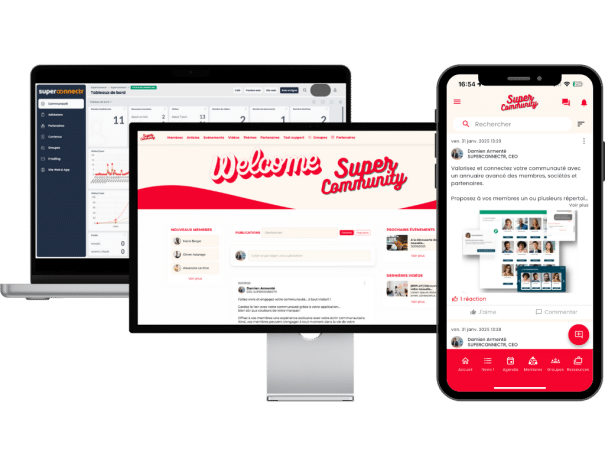
Once you've laid the foundations, you'll need to choose the right tools to support the growth of your community.
These tools must not only centralize data, but also facilitate communication and interaction, automate certain tasks and enhance exchanges between members.
The essential features of a community management and animation platform include :
Fine-tuned management of member profiles and status
- Manage memberships, payments and entitlements
Creating thematic groups or circles
- Internal communication about your news to your members
The ability to publish and comment on content
Event creation and management
A messaging system or direct exchange space
Reporting tools to monitor activity
- A showcase website to promote your community, a private community website and/or a community mobile application
The aim is to enable both simple management on the administrator's side and a fluid experience on the user's side.
And don't forget mobile ergonomics, which are essential today if you want your members to be able to interact wherever they are, and increase engagement at all times.
Depending on your objectives and your audience, you will need to choose a community platform suitable.
Some solutions, such as SuperConnectr, help you manage members, publish content, organize events, segment your base, create a directory or send targeted email campaigns on an online community platform and/or a community application100% in the colors of your company or association brand.
5. Launch the first community interactions

The first nucleus is essential: most of the time, they will become your ambassadors.
It acts as a catalyst: if you involve well-chosen profiles from the outset, they will co-create the first standards, contribute to the first content and inspire the next members.
Identify enthusiastic members with high engagement potential from the outset, offer them exclusive content or spaces, and above all listen to their feedback to refine your community experience.
Before animating a large community, start by creating an active core. Invite a few key members to interact, suggest topics and share experiences. This creates an example effect and encourages organic engagement.
6. Set up a regular animation plan
A community without regular animation becomes silent, then invisible. A good animation plan relies on a diversity of formats (events, content, direct exchanges) and coherence with the community's life highlights.
To maintain a lively, ongoing dynamic, it's useful to structure your animation around several complementary levers: plan moments of inspiration (quotes, feedback), participation (surveys, calls for contributions), and recognition (highlighting members). The key is to create rhythm without saturating your members.
L'community animation is based on regularity. Plan a calendar with a variety of formats: inspirational posts, sector or business intelligence, testimonials, interviews, webinars, events, surveys, etc. Each action should bring the mission to life and nourish the bond between members.
7. Identify and promote your ambassadors
A community involvement is a strategic asset. As soon as certain members speak up, spontaneously help or federate other members, identify them as ambassadors.
To reinforce their commitment, you can offer them symbolic recognition (badges, visibility, privileged access), but also involve them in co-hosting (conferences, private groups, voting, beta-testing). An active ambassador attracts and reassures, embodying the community's culture.
Some members will naturally be more involved than others. These are your future ambassadors. Give them a role, value their contributionsInvolve them as co-leaders. They'll be powerful relays in developing the group dynamic.
8. Data-driven community management

L'animating a community can (and should) rely on performance indicators. Analyze the evolution of registrations, connection rates to your platform, reactions to content, or participation in events.
Measuring the vitality of a community requires both quantitative data (number of participations, connection rates, event attendance) and qualitative data: which topics arouse enthusiasm? Which formats trigger conversations?
You can't run a community by instinct. Analyze activity, participation rates and the most engaging content. Adjust your actions according to feedback, and measure progress. Modern community tools offer comprehensive dashboards for this purpose.
9. Industrialize without dehumanizing
The more your community grows, the more complex the management load can become. It becomes essential to automate certain actions: welcome messages, event reminders, membership reminders, e-mail summaries of new community activities, push notifications on your community application...
This frees up your time for high value-added interactions.
However, be careful not to fall into cold automation. Every point of contact must remain human: personalize your messages, keep your voice authentic, regularly offer sincere spaces for exchange. It's the balance between automation and attention that will make the difference.
Modern tools make this hybridization possible: automating repetitive tasks while maintaining moments of privileged human contact. Only then will the community grow with confidence and involvement.
As your community grows, it becomes essential to structure repetitive tasks (welcoming new members, reminders, role management, moderation, etc.). Automate what can be automated... without forgetting the authenticity of human relations.
10. Anticipate the evolution of your community
Building a community doesn't mean freezing a system. A successful community is in perpetual motion. It evolves with its members, its partners, its technological environment, and even with the social or economic context.
To keep it relevant and alive, plan regular listening sessions: satisfaction questionnaires, qualitative interviews, surveys, co-construction sessions.
These times enable us to detect new expectations, identify weak signals and prioritize improvements.
Evolution also involves innovation: new meeting formats, experimental tools, changes to the business model or mode of governance...
Stay on top of trends and involve your members in the choices you make. They'll be all the more loyal and active for it.
Organize regular debriefing sessions (feedback, internal surveys, collaborative workshops) and document what has been learned. A strong community is one that knows how to renew itself without denying its essence.
A living community is one that evolves. Expectations change, members rotate, customs evolve.
Stay tuned, organize feedback sessions, open up new formats, test innovations... without ever losing sight of your initial mission.
Conclusion: building and maintaining a community
Building a community is much more than a series of tools or actions: it's a human and collective adventure, based on a shared vision of the community. strong missiona commitment and a clear vision.
Each stage covered in this article - from defining objectives to anticipating change - is an essential building block for building a collective sustainable, useful and inspiring.
At a time when brands and organizations can no longer be satisfied with mere audiences, communities become powerful levers of connection, loyalty and value creation.
Take the time to lay the foundations, involve your members from the outset, listen to them, value them... and you'll see the emergence of much more than just a group: a truly committed ecosystem with a wealth of connections!
FAQ (Frequently Asked Questions)
What's the difference between building and animating a community?
Building a community involves laying the foundations: mission, target, tools, structure. Animation then comes into play to bring this base to life: events, content, interaction.
What is the role of a Community Builder?
The Community Builder designs the community strategy, lays the foundations, structures the tools, federates and animates the members. He's the community's conductor.
What tools are needed to build a professional community?
Community platforms like SuperConnectr make it possible to centralize everything and facilitate member management and membership, share your content, create and manage your events, have access to a directory, create groups, facilitate interaction via messaging or a forum, measure community activity thanks to data and statistics...
How long does it take to build a community?
Depending on ambition, this can range from a few weeks (small pro network) to several months or years for larger or multisite communities.
Why build a community in 2025?
Because brands are no longer just looking to capture an audience, but to create loyalty, commitment and shared value with their publics. Building a community helps to develop a sense of belonging and create an exclusive bond with its members, subscribers, customers, partners, learners...
Discover the SuperConnectr community platform!
An all-in-one community platform, 100%, customized with your brand identity.
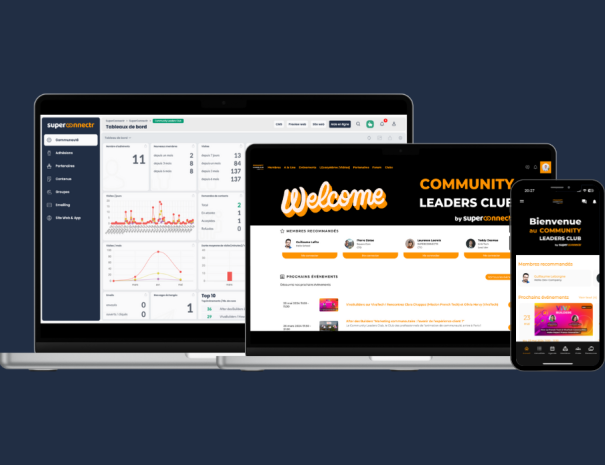
Give the members of your network a community web Platform and mobile App with your Brand to manage, engage and promote your community!
 FR
FR  EN
EN  US
US
Leave a Reply